


From Research to Practice: Triangular Fibrocartilage Complex (TFCC) Rehab

If your instinct with wrist injuries is still to protect first and load later, this case might make you pause.
Abhishek didn’t injure his wrist on a badminton court. It happened while lifting a heavy flower pot.
A quick twist and an awkward load led to a sharp pain on the ulnar side of his wrist that didn’t quite settle the way he expected it to. A few weeks later, he was still struggling with gripping, turning door handles, and more frustratingly, holding his badminton racquet with any confidence.
At 34, working long hours as a software engineer and relying on badminton to stay active, this wasn’t just about pain. It was about losing a part of his routine.
Clinical setup: The wrist that didn’t trust itself
Abhishek presented around five weeks post-injury with:
- Ulnar-sided wrist pain, especially with rotation
- Pain during gripping and weight-bearing
- Occasional clicking with pronation and supination
- Reduced confidence using his dominant hand
He had been told it was likely a Triangular Fibrocartilage Complex (TFCC) injury. Rest and bracing initially helped, but symptoms returned as soon as he tried to load the wrist again. His goal was simple: “I just want to play badminton without thinking about my wrist.”
Subjective and objective assessment
From the subjective assessment:
- Pain was localized and activity-dependent
- No neurological symptoms or red flags
- Fear around twisting and loading movements
- Avoidance of wrist-intensive tasks
Objectively:
- Pain at end-range supination
- Grip strength around 60% of the opposite side
- Pain with ulnar deviation and compression
- Reduced tolerance to weight-bearing
- No gross instability
This wasn’t a case of poor healing. This was a capacity and confidence gap.
Where research shaped my approach
A few key Physio Network Research Reviews helped guide how I approached Abhishek’s rehab, not by giving me a rigid protocol, but by helping me make better decisions.
One case-based Research Review on conservative TFCC management highlighted both what works and what’s often missing. The athlete in that case improved with a progressive loading program over eight weeks, but the process lacked clarity around strength dosage, objective tracking, and importantly, a structured return to sport. That stood out. It reinforced the value of progressive loading, but also the need to go beyond time-based rehab and build in clear progression markers and sport-specific preparation, something I made a priority with Abhishek.
Another Research Review examining MRI in TFCC injuries added an important layer to clinical reasoning. While MRI can be useful in identifying a tear, it often struggles to accurately localize more complex peripheral or foveal injuries due to the anatomical complexity of the region. More advanced imaging can provide additional detail, especially when instability is suspected, but the key takeaway for me was simple: imaging can inform, but it does not always dictate early management. In Abhishek’s case, where symptoms were stable and improving, we chose to prioritize clinical progression over early imaging, keeping it as a backup if things plateaued.
Together, these Reviews reinforced a clear direction. Focus on graded loading, objective tracking, and a structured return to sport, rather than over-relying on rest or imaging.
Rehab strategy: Turning evidence into action
Phase 1: Calm it down and start loading (Weeks 1-2)
Goals:
- Reduce irritability
- Reintroduce load safely
- Build trust in movement
Interventions:
- Wrist isometrics for flexion, extension, and radial/ulnar deviation
- Gentle grip work using putty and towel holds
- Theraband-assisted movements
- Education around pain versus damage
Some pain during loading was considered acceptable provided it remained controlled and settled appropriately. The shift here was subtle but important, moving from protecting the wrist to preparing it.
Phase 2: Build strength and capacity (Weeks 3-6)
This is where the research-informed progression came into play.
We introduced graded loading:
- Grip strengthening with progressive resistance (see Table 1)
- Wrist curls and rotational loading
- Kettlebell carries and holds
- Closed-chain loading progression
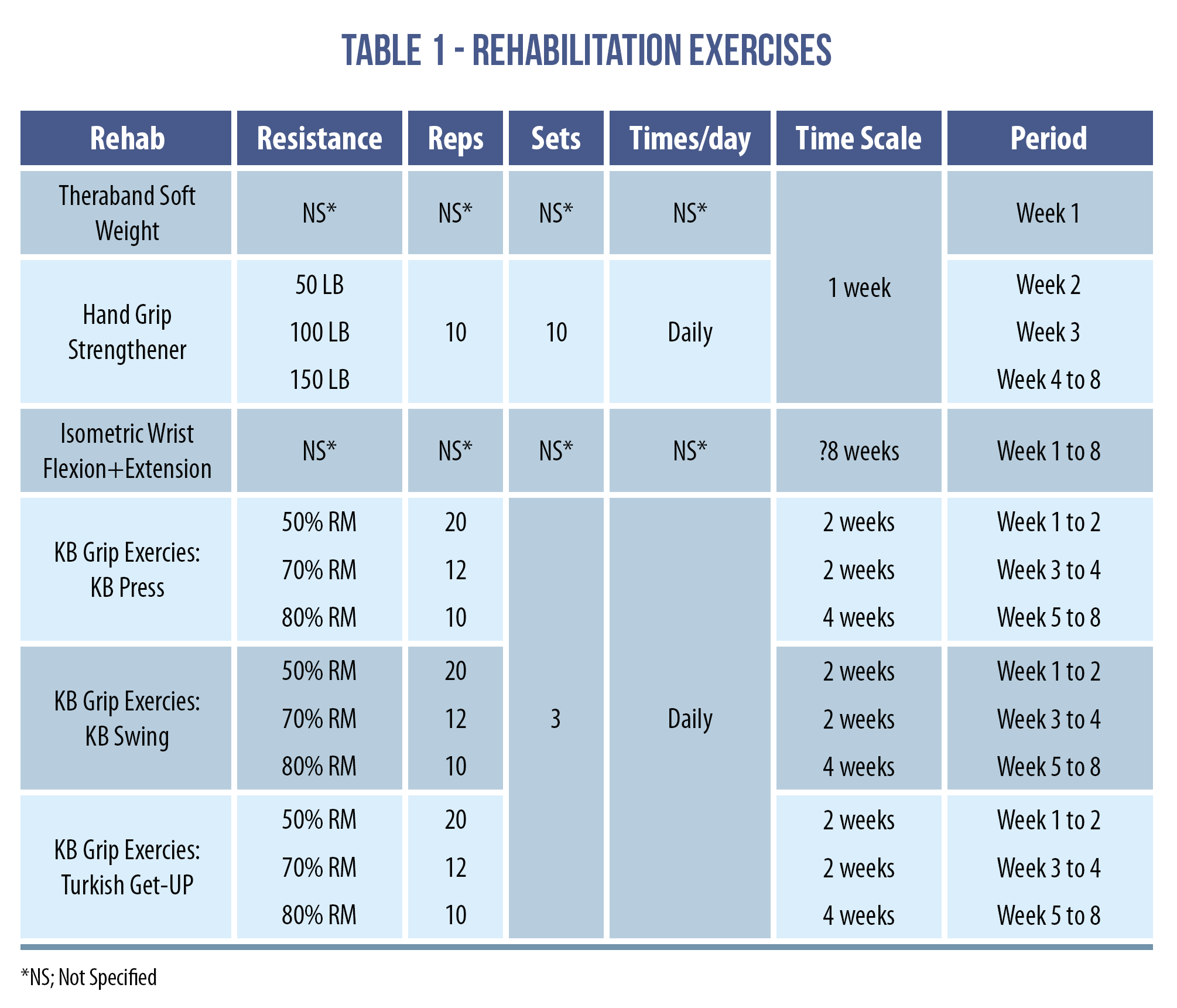
We also integrated:
- Kettlebell press variations for stability and grip
- Dynamic loading patterns such as swing-based work
Unlike the case study from the Review, where loading progressed but was not clearly structured around strength principles, I was more deliberate with load progression within meaningful effort ranges, volume tracking, and objective markers such as grip strength and load tolerance.
By week 6, grip strength was around 85%, pain was significantly reduced and confidence was improving.
Phase 3: Return to sport (Weeks 7-10)
This is where many TFCC cases struggle. Because returning to badminton is not just about strength. It is about speed, reaction, and trust.
We introduced:
- Reactive grip drills
- Racquet handling progression
- Multi-directional wrist loading
- High-speed movement simulation
One key addition was fatigue-based drills, as sport does not happen in controlled sets. It happens under fatigue. We also practiced controlled fall and brace strategies to reduce fear around re-injury.
Return to sport criteria
Before full return, Abhishek met:
- Pain-free full range of motion
- At least 90% grip strength symmetry
- Full weight-bearing tolerance
- No hesitation during high-speed movements
- Confidence in match-like scenarios
He returned to badminton around 9 to 10 weeks, starting with decent duration sessions and progressing gradually.
Wrapping up
TFCC injuries often fall into a frustrating cycle. Rest, relief, return, flare-up.
Breaking that cycle requires more than time. It requires progressive, meaningful exposure to load. The research did not provide me a perfect protocol. But it gave me clarity on when to load, how to progress, and what actually matters. And in Abhishek’s case, that made all the difference. Most people do not need to protect their wrist forever. They need to prepare it for what life and sport demands of it. Because eventually, the question isn’t, is it healed, it’s can it handle what you are asking of it?
Want to make better clinical decisions with less guesswork? If you want research that actually translates into real-world practice and not just theory, subscribe to Physio Network’s Research Reviews. Because the real skill is not just knowing the research. It is knowing how to use it.
📚 Stay on the cutting edge of physio research!
📆 Every month our team of experts break down clinically relevant research into five-minute summaries that you can immediately apply in the clinic.
🙏🏻 Try our Research Reviews for free now for 7 days!

Don’t forget to share this blog!
Related blogs
View allElevate Your Physio Knowledge Every Month!
Get free blogs, infographics, research reviews, podcasts & more.
By entering your email, you agree to receive emails from Physio Network who will send emails according to their privacy policy.
Leave a comment
If you have a question, suggestion or a link to some related research, share below!