


From Research to Practice: Rebuilding Trust after Wrist Surgery

What you think is helping you… is actually slowing you down.
Arpan didn’t expect a wrist fracture to derail his season. At 29, basketball was more than just a weekend hobby, it was his stress release, his social circle, and the one thing that made long workdays feel worthwhile. A fall during a fast break changed that in seconds.
He landed on his outstretched hand, heard a crack he still remembers vividly, and by the end of the night was staring at an X-ray showing a displaced distal radius fracture. Surgery followed soon after. Plates. Screws. A neatly dressed incision.
Three months later, he walked into my clinic convinced that resting more, avoiding load, and “being careful” was the smartest way forward. That belief – common, well-intended, and deeply limiting – became our first rehab challenge.
Clinical set-up: The athlete who didn’t trust his wrist
Arpan was now 10 weeks post-operative fixation of a distal radius fracture. His surgeon had cleared him for physiotherapy with “progressive strengthening as tolerated.” On paper, everything looked good.
In reality, he had:
- Persistent wrist stiffness
- Pain at end-range extension
- Weak grip strength
- Hesitation during weight-bearing
- Anxiety about falling again
- Zero confidence catching a ball
His goal was clear: return to basketball without thinking twice about his wrist. But functionally, he was stuck.
Subjective assessment: What the wrist was saying (and what Arpan wasn’t)
Arpan described his pain as “tight and uncomfortable,” not sharp. It flared with push-ups, floor contact, and sudden movements. He avoided using the wrist during daily tasks whenever possible.
Key subjective points:
- No numbness or tingling
- No night pain
- No signs of infection or complex regional pain syndrome
- High fear of re-injury
- Strong belief that “loading too early” could damage the hardware
This fear made sense, but the evidence would later challenge it.
Objective assessment: Capacity lagging behind healing
On examination:
- Wrist extension was limited by ~20° compared to the other side
- Supination slightly restricted
- Grip strength was ~55% of the contralateral side
- Pain with closed-chain loading (quadruped position)
- Good scar healing, no swelling
- Poor wrist proprioception during fast movements
Red flags were ruled out. No signs of tendon rupture or nerve compromise. This wasn’t a healing issue anymore. This was a capacity and confidence issue.
Where research changed my approach
Two Physio Network Research Reviews strongly shaped how I managed Arpan’s rehab, especially the balance between protecting healing tissue and restoring athletic function.
Review #1 – Wrist Fracture Rehab – Effects and Moderators by Dr Ian Gatt
This strongly influenced my early decision-making with Arpan by reinforcing that post-wrist fracture rehab doesn’t lend itself to rigid protocols.
While pain reduction and return to function remain the primary goals, the evidence highlights wide variability in outcomes and limited clarity around optimal exercise dosage and progression. Rather than defaulting to passive modalities, which the Review suggests offer little benefit, I focused on early, progressive mobilization and a structured home-based program supported by targeted supervised sessions.
This approach suited Arpan’s lifestyle, encouraged ownership of his rehab, and allowed me to individualize loading based on objective markers like grip strength, weight-bearing tolerance, and functional tasks, rather than relying on frequency of clinic visits alone.
One key message stood out: Prolonged immobilization or over-protection delays functional recovery. For Arpan, this meant we had already waited long enough.
Review #2 – Long-term Impact of Wrist Fractures on Basketball Performance by Dr Ian Gatt
This Review shifted how I framed return-to-play expectations with Arpan.
While basketball athletes often appear to regain traditional performance metrics post-wrist fracture, deeper analyses suggest subtle but meaningful drops in efficiency, likely influenced by both physical limitations and psychological factors such as reduced confidence or guarded play.
This insight pushed me to look beyond pain-free range and basic strength benchmarks. With Arpan, we prioritized sport-specific efficiency: quicker shot release under fatigue, repeated ball-handling drills, and controlled contact scenarios to rebuild decisiveness. We also openly discussed fear, hesitation, and trust in the wrist, acknowledging that true return to performance isn’t just about numbers, it’s about how confidently and efficiently an athlete uses the injured limb again.
Rehab strategy: Turning evidence into action
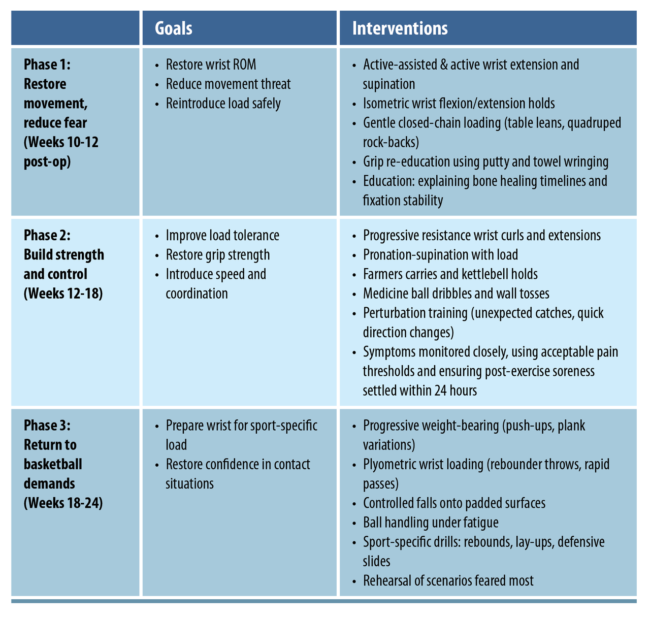
The message was simple: “Your wrist isn’t weak because it’s broken. It’s weak because it hasn’t been asked to work yet.”
Below is the 3-phase rehab plan we implemented:
Safe return to sport
Criteria for return to basketball included:
- Pain-free wrist ROM
- ≥90% grip strength symmetry
- Tolerance to full weight-bearing
- No apprehension with catching or falling
- Confidence during sport-specific drills
Arpan returned to non-contact training at ~5 months post-op and full basketball participation closer to 6 months. Well within evidence-supported timelines for high-demand athletes.
Wrapping up
Arpan’s case reminded me that healing and recovery are not the same thing. Bones heal on timelines, while confidence rebuilds through experience. Over-protecting athletes often delays their return more than early, intelligent loading ever would.
The research didn’t just guide my exercise choices, it gave me the language to reassure, educate, and challenge unhelpful beliefs. When Arpan sent me a video of his first game back, his caption said it all: “Didn’t think about my wrist once.” That’s success.
Want more research translated into practical rehab decisions like this? Subscribe to Physio Network’s Research Reviews and get clinically relevant evidence you can apply straight away, without the overwhelm!
📚 Stay on the cutting edge of physio research!
📆 Every month our team of experts break down clinically relevant research into five-minute summaries that you can immediately apply in the clinic.
🙏🏻 Try our Research Reviews for free now for 7 days!

Don’t forget to share this blog!
Related blogs
View allElevate Your Physio Knowledge Every Month!
Get free blogs, infographics, research reviews, podcasts & more.
By entering your email, you agree to receive emails from Physio Network who will send emails according to their privacy policy.
Leave a comment
If you have a question, suggestion or a link to some related research, share below!