


From Research to Practice: Cervicogenic Headache

Emma loved climbing. Three or four evenings a week, she’d finish work, leave her laptop behind and head to the wall. She was reasonably strong, active, and had been climbing recreationally for several years.
But everything in between involved 8–9 hours at a laptop, with long periods looking slightly down at a screen, little variation in position, and a tendency to work through the afternoon without moving much because she was ‘in the zone.’
Then the headaches started.
Emma was 38 and had been getting headaches for around five months. They usually started around the upper right side of her neck and the back of her head, sometimes travelling towards the temple and behind the eye. They were more likely after a long workday and sometimes after climbing, particularly sessions involving a lot of overhead looking and sustained neck extension.
She had started wondering whether climbing was causing the problem. I wasn’t so sure.
And this is where cervicogenic headache becomes clinically interesting; we first had to understand the source of her symptoms, and build a picture of contributing factors to start addressing Emma’s problem. Here’s how we did it, guided by the evidence summarised in Physio Network’s Research Reviews.
Is it actually coming from the neck?
Cervicogenic headache is classified as a secondary headache, meaning the headache is attributed to a disorder involving the cervical spine or surrounding structures. But neck pain and cervical findings aren’t specific to cervicogenic headaches.
People with migraine and tension-type headache can also have neck pain, altered cervical movement and increased sensitivity around the neck. The trigeminocervical system provides a plausible explanation for why symptoms from cervical structures can be experienced in the head, but that doesn’t mean finding a tender muscle or a stiff segment automatically identifies the source of someone’s headache. That distinction mattered with Emma.
My assessment started before touching her neck
First, I wanted to understand the headache itself, which involved a lot of questions: When did it start? How often did it occur? How long did each episode last? Where did it start, and where did it travel? Was it unilateral or bilateral? What brought it on? Did movement of the neck reliably reproduce it? Did exercise make it better or worse? Any nausea, vomiting, photophobia or phonophobia? Any visual symptoms? Any dizziness or vertigo? Any recent trauma? Any neurological symptoms? What medications was she taking, and how frequently? And what was happening with sleep, stress and workload?
I also wanted a baseline rather than relying on Emma’s memory several weeks later. A simple headache diary helped track frequency, duration, triggers and what she was actually able to do when symptoms appeared. The Headache Impact Test (HIT-6) and Neck Disability Index (NDI) were useful supplementary measures too, rather than trying to make one questionnaire determine the diagnosis.
Then came the red-flag screen: a sudden thunderclap headache, new neurological deficit, unexplained visual disturbance, syncope, fever or systemic illness, significant recent trauma, a substantial change in an established headache pattern, or other concerning features would change the pathway entirely.
Emma had none of these. Her neurological examination was unremarkable. Her symptoms also didn’t fit neatly into a classic migraine presentation. But I wasn’t particularly interested in winning a diagnostic argument between “cervicogenic” and “tension-type” headache. The overlap between headache disorders is real, and the cervical spine can be involved without necessarily being the sole generator.
Then I examined the neck
Emma had slightly reduced right rotation and extension compared with the left. Her flexion-rotation test was limited to the right and reproduced part of her familiar headache. Her deep cervical flexor endurance was poor, with excessive superficial muscle activity during the test. Cervical and scapular endurance were also relatively low compared with what I would expect for someone who climbs regularly. Palpation around the upper cervical region, suboccipitals and upper trapezius reproduced some of her familiar symptoms.
This is where it would be very easy to say:
“Your C2 joint is stiff” or “Your suboccipitals are tight and causing your headache.”
It sounds plausible. It might even feel reassuring because we have apparently found something concrete. But the research makes me considerably less comfortable with that explanation.
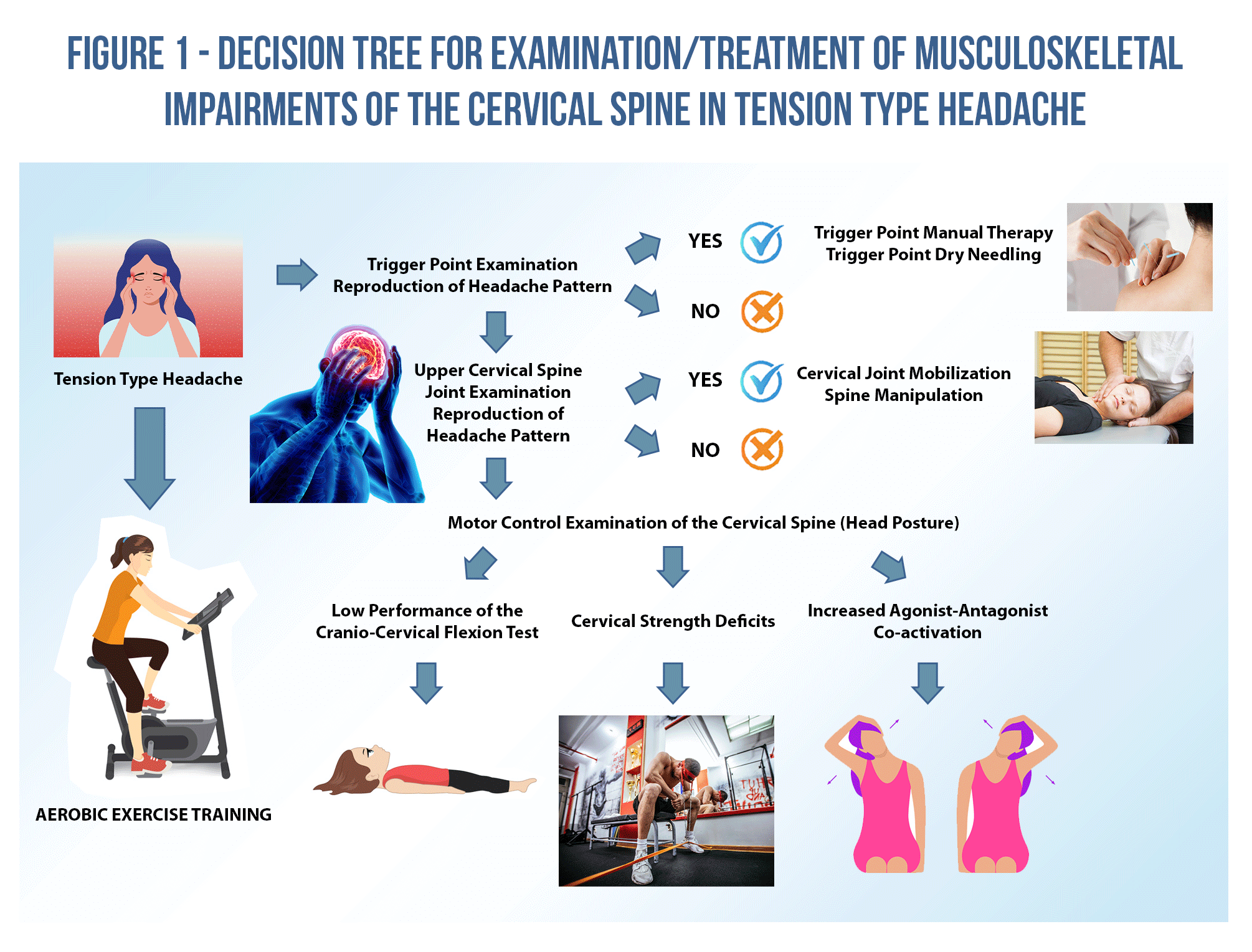
This Review by Dr Julia Treleaven suggests that people with tension-type headaches can demonstrate reduced cervical ROM, altered motor control, increased muscle activity and reduced neck strength. But these findings don’t establish that the neck is causing the headache. They may be consequences of pain or sensitivity, and they don’t necessarily correlate with headache characteristics. Even reproducing headache with pressure over an upper cervical joint or muscle doesn’t settle the question. It may indicate that the structure is contributing. Or it could reflect increased sensitivity within the trigeminocervical system. And not everybody with tension-type headaches demonstrates the same response.
So rather than telling Emma that I’d found “the muscle” or “the joint”, I treated these findings as pieces of a larger clinical puzzle.
What about dizziness?
Emma occasionally felt “a little off” when she moved quickly after sitting at her desk, so I checked eye movements, smooth pursuit, saccades and vestibulo-ocular responses, alongside her balance and symptom reproduction with head movement. Although she didn’t describe classic positional vertigo, it wasn’t my leading hypothesis. Still, I included positional testing such as Dix-Hallpike, which didn’t reproduce vertigo or her familiar symptoms.
That didn’t prove her vestibular system was irrelevant. It simply made it a less convincing explanation for this particular presentation.
The first goal wasn’t to “fix” her neck
I think this is where treatment can become unnecessarily complicated. If I’d convinced Emma that her headache was caused by a stiff C2 segment and tight suboccipitals, every future headache could become evidence that something had “gone out” again. Instead, I explained that her neck seemed to be one modifiable contributor, but probably not the whole story.
We started with a combination of symptom modulation and active rehabilitation.
For the first two to three weeks, the focus was:
- comfortable cervical rotation and extension
- low-load deep neck flexor work
- cervical isometrics
- scapular endurance exercises
- thoracic extension and rotation
- controlled head movement
- breathing and general relaxation strategies
- maintaining normal daily activity
- reducing long, uninterrupted periods at the desk
This is also where I’d use manual therapy deliberately rather than ideologically.
This Review also by Dr Julia Treleaven suggested that multimodal, non-pharmacological approaches produced better short-term outcomes than several single-modality approaches. Combinations involving manual therapy with exercise, and in some analyses manual therapy with dry needling, performed particularly well for headache intensity, frequency or disability. I used upper cervical and thoracic manual therapy as it helped Emma move more comfortably and reduced symptoms enough to make active rehabilitation easier. The point is that manual therapy and exercise don’t have to be competing philosophies.
And what about dry needling?
Emma didn’t particularly enjoy needles, so we didn’t need to force the issue. Although dry needling appeared in some of the high-performing treatment combinations in the research, it was generally part of a broader package involving manual therapy and/or exercise. So if a patient likes it, finds it useful, and has no contraindications, dry needling could be considered as an adjunct. But it’s important not to let the ranking of an intervention in the research trump a patient’s comfort or preference.
Then we made her stronger
By weeks 3-8, rehabilitation became less about the headache and more about the person who wanted to climb.
We progressed cervical strengthening, rows, pulldowns, carries, serratus work and thoracic exercises. We gradually increased resistance and duration rather than treating the neck as something that needed to remain delicate. We also started exposing Emma to the positions she’d begun avoiding, namely looking up, reaching overhead, holding her head in different positions while moving and climbing for longer.
The aim wasn’t to find the perfect posture. It was to increase her tolerance for the things she actually cared about.
But it’s important not to oversell the evidence for neck strengthening – this Review explains that a progressive neck-shoulder exercise programme was well tolerated and reduced headache frequency substantially over 6 months. The exercise group went from roughly four and a half headache days/ week to around two and a half. That sounds impressive until you look at the other group. The control group also improved by around 30%.
There were no meaningful between-group differences in headache intensity or duration, and overall changes in neck disability and function were modest.
So I didn’t tell Emma:
“Strengthening your neck will reduce your headaches.”
What I explained was:
“You have some measurable cervical capacity deficits, and improving them seems worthwhile. Let’s see whether that changes your symptoms and what you can do.”
That was a very different proposition.
The Review also points out that aerobic exercise has evidence for improving headache intensity, frequency, duration and quality of life in people with chronic headache. So general physical activity shouldn’t disappear from the treatment plan simply because we’ve found a few cervical impairments. For Emma, climbing itself was already a form of physical activity. Rather than removing it, we used her existing activity as part of the rehabilitation and gradually built her tolerance around it.
The final stage was not “discharge”
Around weeks 8-12, Emma was climbing again 3-4 times per week. We added more climbing-specific conditioning and sensorimotor work: controlled head repositioning, visual tracking, eye-head coordination and balance tasks where relevant. The purpose wasn’t to suggest that her headache was caused by poor proprioception; rather, it was to give her a broader movement repertoire and more confidence with the demands of her sport. We also stopped treating every headache as a setback. Her headache frequency gradually fell from several episodes each week to around one or two. Episodes were shorter and less disruptive. She could climb without constantly monitoring her neck.
Wrapping up
The interesting part of this case wasn’t finding the “right” cervical joint. It was learning to be suspicious of overly neat explanations. Emma had reduced cervical rotation. She had poor cervical endurance. Palpation reproduced her headache. Her symptoms changed with cervical movement. All useful information. None of it, by itself, proved causation.
And the exercise evidence gives us another useful warning. A statistically significant improvement in headache frequency doesn’t automatically mean the exercise programme produced a large, clinically important change. When the comparison group improves too, and when headache intensity, duration and disability don’t meaningfully change, we need to keep our claims proportionate.
At the same time, that doesn’t make the exercise programme useless. Emma wasn’t a participant in a headache trial. She was a climber with identifiable cervical impairments who wanted to return to a physically demanding activity. That makes cervical strengthening a reasonable thing to test, rather than something to prescribe automatically to everyone with a headache.
This is probably where these 3 Reviews come together – the first reminds us that cervical findings don’t automatically prove that the neck is causing the headache. The second suggests that multimodal rehabilitation, particularly combinations of manual therapy and exercise, may produce better short-term outcomes than relying on a single approach. And the third reminds us to keep our enthusiasm for neck strengthening in check, while considering whether the patient in front of us actually has cervical impairments that make this approach particularly relevant.
So perhaps the better question isn’t:
“Which treatment is best for cervicogenic headache?”
Maybe it is:
“What does this particular person need to get better, and which parts of the evidence actually apply to them?”
Want to go deeper into the evidence behind cases like this? Subscribe to Physio Network’s Research Reviews and keep the latest research coming into your clinical reasoning, rather than waiting for it to find you.
📚 Stay on the cutting edge of physio research!
📆 Every month our team of experts break down clinically relevant research into five-minute summaries that you can immediately apply in the clinic.
🙏🏻 Try our Research Reviews for free now for 7 days!

Don’t forget to share this blog!
Related blogs
View allElevate Your Physio Knowledge Every Month!
Get free blogs, infographics, research reviews, podcasts & more.
By entering your email, you agree to receive emails from Physio Network who will send emails according to their privacy policy.
Leave a comment
If you have a question, suggestion or a link to some related research, share below!