


Strength and Conditioning in Physiotherapy – How Much is Enough

Note: This is an updated version of an article I did for my own blog in 2018.
As a physio, strength coach and semi-retired powerlifter who has worked with and learned from people who have squatted over a thousand pounds to people who can barely get out of their own chair, it got me thinking: “for the regular person who’s not a competitive athlete and just wants to look good, feel good, and be healthy, how much strength is enough? How much cardiovascular fitness is enough? At what point does trying to improve those areas become detrimental to health and cross-over into high performance athletics?” That is the topic of today’s article.
If you’re interested in learning more about effective exercise for clinical and athletic populations, checking out the Physio Network Masterclasses:
Perspective #1: We should just let people do the activities they want and live their life that way
There’s a lot to be said for this especially given the rates of obesity and inactivity in the world. To quote Stan Efferding “the best form of activity is the one you’ll do and stick to.”
From a compliance perspective – yes it’s important that people enjoy the activities that they are doing. Not everyone enjoys running or slugging weights. It is what it is. As much as people like to knock CrossFit – it’s helped to excite a lot of people to get physically active and has a great sense of community.
My only concerns with this perspective are two fold:
Concern 1 – In some regions, especially in my home and current country of Canada where it seems to be either cold and snowy or stinking hot all year, many activities that people enjoy (i.e. certain sports, walking, gardening) just don’t get done. What good is an activity if you’re not doing it for five months (or more) out of the year?
Concern 2 – Are these activities enough to build both strength, cardiovascular fitness, lean body mass, and bone density?
Furthermore, look at the person who just walks and does things around the house and then has a heart attack during the first major snowfall of the winter while shovelling snow. Those activities that the person took part in did not prepare them enough for a more physically demanding (yet essential) task.

Some research has questioned whether low intensity activities such as walking can provide enough of a stimulus to maintain health, especially through the aging process (1).
As such, while it’s important that people pick activities they enjoy, they need to be done consistently and there needs to be enough of a stimulus to promote health and to enable more strenuous essential activities to be done while still maintaining a reserve of physical function afterwards.
Perspective #2: We should turn all our physical therapy or personal training clients into powerlifters, endurance athletes or functional fitness freaks
As my friend Nick Tumminello said we tend to train our clients based on our specific biases – whether it’s cardio, bodybuilding, powerlifting, kettlebells, Crossfit or the like.
While all of these activities can have great benefits on physical function – my concerns are two fold.
First of all, these activities carry a higher health risk than just training for general health.
Stan Efferding has said (2) “if you want to be healthy don’t compete.” While strength sports such as bodybuilding, powerlifting, strongman, and Crossfit do have an injury rate comparable to (or slightly less than) those of non-contact sports (3), an injury rate ranging from 1 every 10 years to over 1 per year is a lot for someone who’s not pursuing highly competitive athletics. In addition, there are other health risks involved from carrying too much body weight which include osteoarthritis (OA), insulin sensitivity, high blood pressure, and sleep apnea.
Endurance sports, while widely considered to be healthier than strength sports, actually have a much higher rate of injury (4). In a very popular and semi-recent paper recreational runners are less likely to develop knee OA than the sedentary population, however, competitive runners are more likely to develop knee OA (5). In addition, the relationship between cardiovascular fitness and health is not 100% linear. High performance endurance athletes can have higher mortality and adaptations of the heart that can predispose them to other health issues (6).
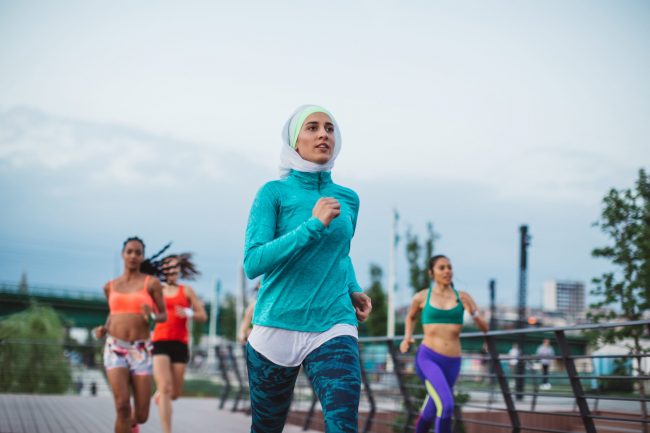
Secondly … training like a high-level athlete can become very burdensome from a time, effort and money perspective. Many high-level athletes train, eat, sleep and recover like it’s their job. Eating 6 meals a day, being in bed by 8 to 10 every night, not being able to go out much, and training 8-10+ hours a week doesn’t seem like the lifestyle most people want to live when their goal is just to be healthy.
As such – training like a competitive athlete isn’t the answer either.
Well, what is the answer?
It’s tough to give specifics without understanding a person’s goals, general health, and demands of his or her life.
A good general guideline for what I consider to be “sufficient” strength and cardiovascular fitness is for people to:
- Be able to do physically demanding activities such as factory and farm work, help move furniture, and be able to play some sports with coworkers/kids without these tasks being a “max effort” or causing such fatigue or muscle soreness that they can’t be performed consistently.
- Have appropriate levels of bone density and lean body mass
…all throughout the lifespan. Some may disagree but that’s my standard.
Some good specific indicators of fitness are the following:
- Being able to do at least 40 pushups straight (7)
- Being able to stand on one leg (eyes open) for at least 20 seconds (8)
- Being able to run a mile in at least 8 minutes (9)
- A Timed Up and Go (or TUG) time < 12 seconds (10)
For most people who are healthy, 2-4 days a week of some well designed strength training and a bit of cardiovascular exercise (or playing some kind of recreational sport) along with some NEPA (non exercise physical activity such as moving at work), should have the desired effect without being burdensome or counterproductive to health.
Wrapping up
I hope this article provided some useful food for thought on making the distinction between optimal health and optimal athletic performance. As always – thanks for reading.
If you’re interested in learning more about effective exercise for clinical and athletic populations, checking out the Physio Network Masterclasses:
Want to learn how to optimise your exercise prescription for older adults?
Dr Mariana Wingood has done a Masterclass lecture series for us on:
“Exercise prescription for aging adults”
You can try Masterclass for FREE now with our 7-day trial!

References
Don’t forget to share this blog!
Leave a comment (1)
If you have a question, suggestion or a link to some related research, share below!
You must be logged in to post or like a comment.
Related blogs
View allElevate Your Physio Knowledge Every Month!
Get free blogs, infographics, research reviews, podcasts & more.
By entering your email, you agree to receive emails from Physio Network who will send emails according to their privacy policy.
hey excellent stuff man. yes i think it is very client dependent and depends on what the patients goals are although we likely need to be educating patients to a higher goal in the general population.
It was also eye opening to hear of the downside of exercise to the newcomer – increase injury risk, OA, heart events and also the time and effort factor too