


From Research to Practice: Rotator Cuff Tendinopathy

I spent years confused about the best way to load a painful rotator cuff. Then I met Shreya.
“I’ve stopped playing badminton, but my shoulder isn’t getting better. So what exactly am I supposed to do?”
Shreya was 37, an IT consultant, and a recreational badminton player who played four to five times a week. Badminton wasn’t just exercise for her. It was how she switched off from work. For around four months, though, her dominant shoulder had gradually become painful. Overhead shots were becoming uncomfortable, smashes were worse, and reaching behind her back had started to bother her. She had reduced her badminton dramatically for three weeks, hoping that rest would settle things. It hadn’t.
What concerned her most wasn’t actually the pain. It was what the pain meant.
“I don’t want to keep irritating the tendon,” she told me. “Should I stop lifting? Should I only do light exercises? Or do I actually need to lift heavy to make it stronger?”
And that was a great question. Because, for years, I had been just as confused about the “best” way to load a painful rotator cuff.
Heavy? Light? Eccentric? Slow? How much? How often?
The recent Physio Network Research Reviews of three important papers helped me approach Shreya’s rehabilitation with a much more useful question: What dose of exercise does this person need, at this point in their recovery, to get back to what matters to them?
First I needed to understand the shoulder, not just label it
Shreya described anterolateral shoulder pain, aggravated by overhead activity and repeated badminton strokes. There had been no significant traumatic event, sudden loss of function or obvious neurological symptoms. She had no constitutional symptoms, unexplained weight loss or other features that raised concern for serious pathology.
Her cervical examination was unremarkable and did not reproduce her familiar symptoms. Shoulder range of motion was almost full, although elevation and hand-behind-back movements were painful towards end range. Resisted abduction and external rotation reproduced her familiar pain, with a mild reduction in force output compared with the other side.
I considered several differentials, including cervical referred pain, adhesive capsulitis, significant rotator cuff tear and other shoulder disorders. Nothing in the history or examination strongly pointed towards these.
Her presentation was most consistent with rotator cuff-related shoulder pain.
But I was also careful about how I explained that diagnosis. This Review by Dr Jarod Hall acknowledges how difficult it can be to determine the precise pathoanatomical source of shoulder pain clinically and therefore uses the broader term rotator cuff-related shoulder pain. That distinction matters. I didn’t need to convince Shreya that one particular tendon was damaged. I needed to understand her symptoms, her current capacity and the demands she wanted to return to.
The Review that changed my relationship with “heavy”
This Physio Network Review by Ben Cormack was based on the RoCTEx trial, which compared progressive high-load strengthening with traditional low-load exercise over 12 weeks.
This was exactly the question Shreya was asking me. The answer was surprisingly reassuring. Both groups improved, but progressive high-load exercise did not demonstrate a superior overall outcome compared with the traditional low-load programme at 12 weeks. The groups also showed similar improvements in pain, strength and range of motion.
So I didn’t have to tell Shreya: “Your tendon needs heavy loading.”
Instead, I could tell her: “Your shoulder needs an appropriate stimulus that we can progressively build. That doesn’t necessarily mean starting heavy.”
This also gave me flexibility around equipment and adherence. Shreya worked long hours and travelled for work. If a programme required a fully equipped gym five days a week, it wasn’t going to survive contact with her real life. So our first phase was deliberately simple.
Weeks 1-3: Find the starting point
We started by reducing the most provocative badminton activities rather than removing badminton altogether. For the first two weeks, she played twice per week, kept sessions shorter and temporarily avoided repeated maximal smashes.
Her rehabilitation included:
- Isometric external rotation
- Supported scaption
- Low-load resisted external rotation
- Rows
- Serratus-focused reaching
- Controlled overhead movement
The exercises weren’t particularly glamorous. That was the point. I wanted Shreya to have something she could perform consistently and confidently. The Review findings gave me confidence that I wasn’t compromising her rehabilitation by beginning with lighter loads.
And there was another interesting finding: both groups improved isometric strength despite training with substantially different loads. That made me question how I interpreted Shreya’s mild strength deficit. Perhaps weakness wasn’t simply a pre-existing problem that had caused her shoulder pain. Pain itself could be influencing how much force she was willing or able to produce. So rather than obsessing over restoring a particular strength number immediately, I treated strength as something we could progressively develop as pain and confidence improved.
Then the dose question became important
By week three, Shreya was tolerating the initial exercises well. Now I wanted to give her a more meaningful training stimulus.
This was where this Physio Network Research Review added another layer to my reasoning. The interesting finding was that, on average, interventions using greater external resistance and lower exercise frequency tended to produce more favourable effects than bodyweight-only or very frequent approaches. However, the evidence around exercise volume was much less consistent.
That didn’t mean: “Heavy is always better.”
It meant: “Once the patient is ready, make sure the exercise provides a meaningful stimulus- and don’t forget recovery.”
That distinction was particularly relevant for Shreya. She was already loading her shoulder through badminton four or five days a week. Adding daily strengthening on top of that would have been a poor interpretation of the evidence.
Instead, I prescribed resistance training three times per week, initially with external resistance that she could tolerate, while maintaining appropriate recovery between sessions.
We progressed:
- Cable external rotation
- Cable internal rotation
- Dumbbell scaption
- Rows
- Landmine press
- Incline push-ups
- Loaded carries
The load increased gradually and the number of exercises didn’t need to explode. The stimulus needed to improve.
Weeks 4-8: Stronger wasn’t the only goal
At this point, something else became increasingly obvious. Shreya was physically improving, but psychologically she was still treating her shoulder as fragile. Every painful repetition triggered the same thought: “Have I damaged it again?”
This was where the next Physio Network Review became particularly valuable.
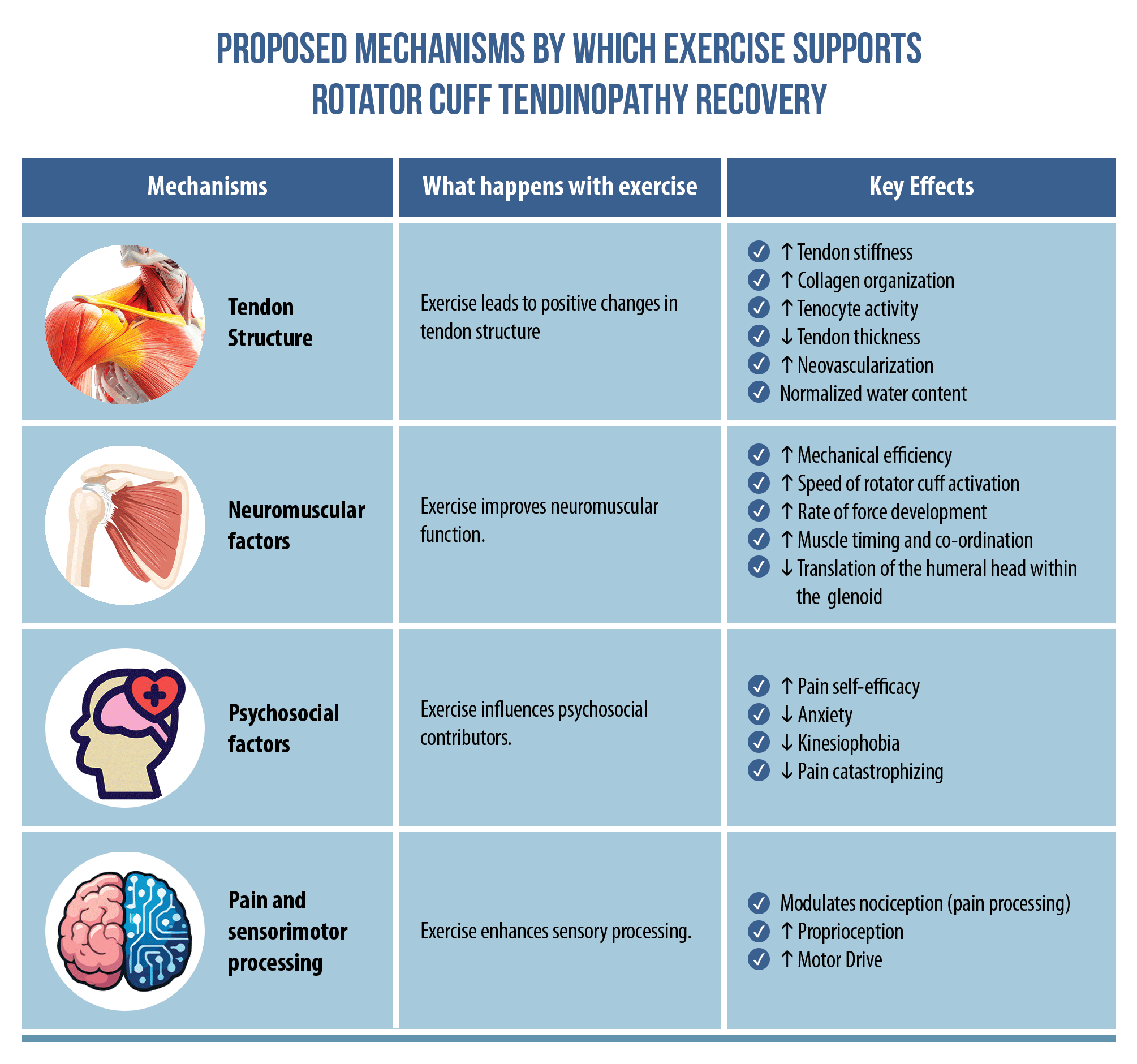
This Review proposed four interacting domains through which exercise may influence recovery: tendon structure, neuromuscular factors, pain and sensorimotor processing, and psychosocial factors.
That gave me a much broader way of explaining what we were doing. Exercise wasn’t simply there to “repair” her tendon. It could help her shoulder adapt to load, improve neuromuscular performance and movement capacity, and potentially influence pain and confidence.
The Review also challenges the idea that a purely mechanical explanation is sufficient for rotator cuff tendinopathy, highlighting the contribution of central pain and sensorimotor processes and psychological factors. So I changed the conversation.
When an exercise caused a mild increase in symptoms, we didn’t automatically interpret that as tissue damage. Instead, we discussed the exercise as an opportunity to gradually expose her shoulder to something she had become fearful of.
For Shreya, the narrative was: “We’re not trying to avoid every sensation. We’re progressively teaching your shoulder that it can tolerate this demand.”
For another patient who understood their symptoms primarily as a capacity problem, I might explain the role of resistance exercise differently- perhaps emphasising adaptation of the tendon and musculotendinous system. The important lesson was that the exercise and the explanation surrounding it should make sense to the person sitting in front of us.
Weeks 8-12: From strength to badminton
By week eight, Shreya had regained much of her confidence with overhead activity.
Now the rehabilitation needed to look more like badminton.
We introduced:
- Faster resisted external rotation
- Medicine-ball throws
- Overhead pressing
- Push-press variations
- Rapid shoulder elevation
- Controlled plyometric wall drills
- Shadow badminton strokes
- Progressively faster overhead movements
This was where I stopped thinking purely about “rotator cuff strength.” Badminton doesn’t ask Shreya to perform a slow maximal external rotation in isolation. It asks her to repeatedly produce force, coordinate the entire upper limb and trunk, react quickly and tolerate fatigue.
This Review helped me appreciate that exercise-related changes in maximal strength don’t necessarily explain all improvements in pain and function. Other neuromuscular qualities, including rapid force production and coordination, may also be relevant. So our final stage became increasingly task-specific.
Returning to the court
Around week 8, Shreya returned to three badminton sessions per week.
We initially kept her intensity around 60-70% and reduced the number of maximal overhead shots.
Over the next four weeks, we progressively increased:
- Session duration
- Number of overhead strokes
- Smash intensity
- Repeated overhead efforts
- Competitive games
By week 12, she was back to four badminton sessions per week. She wasn’t completely symptom-free every day. But that wasn’t our primary marker of success. She could play and she could train. She could respond to an occasional flare-up without immediately assuming that she had damaged her shoulder. And perhaps most importantly, she no longer needed me to tell her whether every movement was safe.
What did these Reviews actually teach me?
This Review challenged my assumption that heavier automatically means better. Different loading strategies can produce meaningful improvement, giving us room to individualise exercise according to symptoms, equipment, preferences and adherence.
This Review then reminded me not to swing too far in the other direction. Once appropriate, we still want a meaningful resistance stimulus, and we should think carefully about recovery. The evidence favoured greater external resistance and less-than-daily frequency on average, while the evidence around volume was considerably less consistent.
This Review made the picture even broader: exercise may influence several interacting systems- not simply tendon structure. It gave me a framework for thinking about tendon adaptation alongside neuromuscular function, pain and sensorimotor processing, and psychological factors. And that changed the way I worked with Shreya.
I stopped asking: “What is the best rotator cuff exercise?”
And started asking: “What does this person need to tolerate, and what is the most appropriate way to progressively expose them to it?”
That might mean light loading initially. It might eventually mean heavy external resistance. It might mean fewer sessions and more recovery. It might mean changing the explanation around pain. And eventually, it has to mean returning to the thing the patient actually cares about.
For Shreya, that was badminton.
Wrapping up
I spent years looking for the perfect loading prescription. The more evidence I read, the more I realised that rehabilitation isn’t about finding one. It’s about understanding dose, progression, recovery, context and the person in front of you.
Research doesn’t always give us a recipe. Sometimes it gives us permission to be more flexible. Sometimes it tells us when to push and when to back off. And sometimes, as in Shreya’s case, it reminds us that the exercise is only part of the treatment- the story we tell the patient about why they are doing it matters too.
If you want research distilled into clinically useful insights that can change the way you assess, explain and rehabilitate musculoskeletal conditions, consider subscribing to Physio Network Research Reviews.
The real value of evidence isn’t knowing more papers but making better decisions when the next patient walks through the door.
📚 Stay on the cutting edge of physio research!
📆 Every month our team of experts break down clinically relevant research into five-minute summaries that you can immediately apply in the clinic.
🙏🏻 Try our Research Reviews for free now for 7 days!

Don’t forget to share this blog!
Related blogs
View allElevate Your Physio Knowledge Every Month!
Get free blogs, infographics, research reviews, podcasts & more.
By entering your email, you agree to receive emails from Physio Network who will send emails according to their privacy policy.
Leave a comment
If you have a question, suggestion or a link to some related research, share below!